
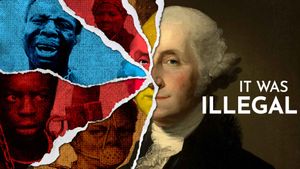
Ona Judge ran for freedom. Washington hunted her until the day he died.

Did you know America almost had three presidents? Yes, really.
That's why we're launching a brand new series on "The America That Almost Was," where we dive deep into the forgotten Constitutional debates that nearly gave us a very different country.
We've produced it in collaboration with Nebula, the streaming platform built by and for creators like us, and it's available exclusively there. Nebula is amazing because instead of chasing ad-dollars and incentivizing doom-scrolling, it's built on subscriber revenue, meaning it's designed to give YOU the best content to keep YOU subscribed.
And if another subscription sounds like a headache, just know you can sign up with our link to bring the price down to just $30/year. There are other streaming services approaching that per month.
So check it out, and catch the first episode of "The America That Almost Was" on the Presidency, right now.
Intro
May, 1796: Philadelphia, temporary capital of the United States. For nearly eight years, President George Washington has lived and worked here in the President's house. But tonight, the Washingtons are preparing to leave, to return home to Virginia, because the President’s term is coming to a close.
While the family dines on a fine meal prepared by their enslaved chef, Hercules, elsewhere in the home Ona Judge, an enslaved woman, is hard at work packing the family’s possessions for the long journey ahead... or so the Washingtons think.
But there’s just one problem. The President has broken the law, and he has no idea what kind of trouble he’s about to be in.
You see, before Washington took office, Pennsylvania began to gradually abolish slavery. And according to Pennsylvania law, Hercules and Ona Judge should have been freed years ago.
That Washington knows. In fact, he’s gone to great lengths to skirt this law and then, eventually, to simply break it repeatedly — but always in secret. What he doesn’t know is that Ona Judge knows that too. And she has no intention of returning to Virginia.
Tonight, she isn’t packing the Washingtons’ things for a journey south. She’s packing hers for a journey north. And just hours later, while everyone else is asleep, Ona Judge collects her bag, creeps through the halls of the President’s mansion, opens a back door, takes a deep breath, and rushes out, disappearing into the warm, dark, free air of the night.
Her journey will not be an easy one. Within days, advertisements begin to appear in papers, describing a “light mulatto girl, much freckled, with very black eyes and bushy black hair, of middle stature, slender, and delicately formed about 20 years of age.” The ads promise 10 dollars “to any person who will bring her home” and are signed by the President’s steward. [A]
Soon, Ona Judge is on a ship heading north — as north as she could get, to freedom — but President George Washington is not about to let her get away.
Origins
Ona Maria Judge was born into slavery here at Washington’s sprawling Mount Vernon estate in 1773, the same year a mob of angry Bostonians hurled tons of British tea into the harbor in protest of taxes they saw as an assault on their freedom. Ona’s father Andrew Judge was a white Englishman — an indentured servant working for Washington — while her mother Betty was a slave legally belonging to George Washington’s wife Martha, who’d inherited over 300 people upon her first husband’s death (N, 5-12).
We don’t know much about Judge’s early life, except that from a young age she was compelled to work extremely long days in the Washingtons’ household as a maid and seamstress (N, 36-37). It’s unlikely she had any experience of life beyond Mount Vernon.
That is, until 1789, when George Washington, just elected as the nation’s first President, took his wife and eight enslaved men and women on the road to Philadelphia, the nation’s capital, while Washington D.C. was under construction (N, 52-54).
Arrival
They arrived in November 1790, and Philadelphia opened up before the Washingtons’ slaves like a new world. Here there was a sight unimaginable back home in Virginia: communities of Black people living as free men and women. For Ona Judge and the others, it must have been bittersweet to see this and to know that freedom lay before their eyes yet so far away.
But in truth, it was nearer than they knew.
In April, Washington's Attorney General Edmund Randolph came by with urgent information (N, 62). Unbeknownst to them both, about ten years ago Pennsylvania had passed a law to gradually abolish slavery (O). Apparently, slaves brought from other states were entitled to their freedom after six months in Pennsylvania. Washington began to panic. He’d been in the state five months already.
But Randolph calmed his fears. The solution was simple: send the slaves away, back to Virginia, then bring them back, and do the same again, every five months (B).
But Washington still had one major concern — what if the slaves found out? He wrote to his secretary that,
Although I do not think they would be benefitted by [being freed], yet the idea of freedom might be too great a temptation for them to resist. At any rate it might, if they conceived they had a right to it, make them insolent in a State of Slavery.
Therefore, he instructed his secretary to arrange the 5-month journeys as Randolph suggested but to take care
To have it accomplished under pretext that may deceive both them and the Public. [B]
Washington knew the American public would be as outraged as any of his slaves, if they learned the truth of his hypocrisy. And though it seems clever, this five-month trick was probably still illegal. We get deep into that legal nitty-gritty in the bonus podcast for this video, which you can get by hitting join down below.
But, for nearly eight more years, the President continued to brazenly skirt or simply break the law to keep men and women in bondage, while concealing this crucial truth from them. In the meantime, Judge continued to labor as Martha’s head servant, maid, and seamstress (E, Ch. 52). In turn, she saw the great parade of dignitaries who came to call on the President.
Once, they were visited by Washington’s friend Senator John Langdon and John’s daughter, Elizabeth, a friend of Martha’s granddaughter (N, 130-131). In time, both John and Elizabeth would prove fateful figures in Ona’s life: one bringing grave danger, the other saving her life.
But for now, when or whether Judge learned about Washington’s deceit, we can’t be certain. We do know that Hercules — the enslaved chef — did eventually find out. It’s likely the word reached Judge not long after.
Either way, she knew that,
If I went back to Virginia, I should never get my liberty. [M]
And so it was, as Washington’s second term drew to a close, that she resolved to attain that liberty, by whatever means. In May of 1796, she ran.
Reaction
The next morning, Martha Washington rang a bell and summoned Ona Judge to her bedroom. But nobody came. At first, she was confused. Then, when she rose and searched for Judge, the truth quickly dawned on her, and Martha flew into a rage. She had no patience for this sort of betrayal.
As she wrote her friend once,
The blacks are so bad in their nature that they have not the least gratitude for the kindness that may be showed to them. [C, 287]
George was no less disturbed, and for him, something wasn’t adding up. Why would Judge run away? They’d treated her so well.
And then he began to put the pieces together. She didn’t run away. She was tricked. Someone must have convinced her to run away, promised her wealth or something else. That had to be the answer. In his words,
There is no doubt in this family, of her having been seduced and enticed off by a Frenchman, who was either really, or pretendedly deranged. [D]
It never occurred to this champion of liberty that maybe — just maybe — Ona Judge simply craved freedom, no matter the cost.
So the Washingtons began placing runaway slave ads. But nothing would come of them. Judge had made numerous friends in the city’s free Black community, and she now found refuge amongst them.
Perhaps Washington could’ve had more luck if he’d demanded help from the Pennsylvania or Philadelphia governments, but that was off the table. He knew that Judge should have been freed a long time ago. So for about a month, Judge hid out in Philadelphia, until she finally arranged passage with a friendly ship captain heading north — anywhere north, away from there.
Discovery
In the meantime, Washington returned to Virginia at a complete loss.
Until, in September 1796, he received a crucial letter from Elizabeth Langdon — dear friend of Martha’s granddaughter and onetime guest at their home in Philadelphia. She had been about town in Portsmouth — her father John being a Senator of New Hampshire — when she spotted someone familiar. It was Ona Judge. [E, Ch. 62]
Washington finally had a lead. Portsmouth was smaller than Philadelphia, especially for Judge. Back then, the town had only a hundred Black people in it [F, 121].
Martha was ecstatic, and she had an idea to get Judge back. A few years prior, George had signed the Fugitive Slave Act into law, which required Northern states like New Hampshire to apprehend and return slaves who’d fled from the South, even if the Northern state had abolished slavery (P). If the Washingtons filed suit in New Hampshire, the authorities would have to arrest Judge and send her back to Virginia.
But George knew better. For one, he loathed to publicize the affair and risk damaging his reputation. [E, ch. 62] And besides, Washington knew that a fugitive slave suit wouldn’t be smooth sailing. Judge had a strong case that she should have been freed years ago.
Then Washington remembered something. He was the President. Did he really have to follow the rules like everyone else? Portsmouth was a major port. That meant customs officers — federal officers—his officers. He had an idea.
On September 1, he wrote his Treasury Secretary, Oliver Wolcott and told him to instruct the Portsmouth port collector,
To sieze, and put [Judge] on board a Vessel bound immediately to [Mount Vernon.] [E, Ch. 62]
Deception
Soon, Joseph Whipple, chief Collector of Portsmouth, began asking after seamstresses in Portsmouth. It didn’t take him long to find Ona Judge. Soon, he approached her and introduced himself, but Wolcott had warned him that Judge may be under the influence of a trickster. Whipple had to be discreet, so he invented a story. He said his family was soon to set sail, and they needed someone with her skills. Judge was cautious, but Whipple was promising good pay, and he seemed a decent man of considerable means. So she agreed.
But something didn’t sit right with Whipple. He didn’t see any evidence of a trickster in Judge’s life. Now, he didn’t want to give alarm — he hated the idea of failing President Washington —
but he began asking Judge some questions. Who was she? Where was she from? How long had she been a seamstress?
It soon became clear to Whipple that Washington had not been totally honest with him. So he wrote Wolcott,
After a cautious examination it appeared to me that she had not been decoyed away… but that a thirst for compleat freedom… had been her only motive for absconding.
So, Whipple was somewhat embarrassed to admit, he’d then revealed his true intentions to Judge. He thought it would be best for everyone if she returned willingly, not under duress or deception. And, shockingly, Judge wasn’t unwilling to compromise. As Whipple wrote,
She expressed great affection & reverence for her Master & Mistress, and without hesitation declared her willingness to return & to serve [them] if she could be freed on their decease.
Judge clarified, however, that without this promise,
She should rather suffer death than return to Slavery & [be] liable to be sold or given to any other persons. [G, ch. 9]
When Washington received the letter, forwarded to him by Wolcott, he was aghast. He wrote Whipple back, chastising him for tipping Judge off to the ruse, and responded to her offer to return by saying,
To enter into such a compromise, as she has suggested to you, is totally inadmissible… However well disposed I might be to a gradual abolition… it would neither be politic or just, to reward unfaithfulness with preference; and thereby… [cheat] her fellow Servants; who by their steady adherence, are far more deserving than herself.
...Not that he'd freed any of them, either.
But Washington hadn’t lost sight of the risk this whole saga posed to his reputation — or public order.
So, though he reiterated his command to Whipple to see it done, Washington added that he must avoid
such violent measures [that] would excite a mob or riot, which might be the case if she has adherents, or even uneasy sensations in the minds of well disposed Citizens. [D]
So Whipple returned to his task, but Judge was frightened. In the meantime, she’d gone to her lover, a sailor named John Staines, and implored him to marry her. Perhaps then, Washington and his mercenaries might leave her alone.
Though Whipple blocked their marriage certificate from being issued, the couple ran to another county and married there. At that, Whipple gave up the chase. About a year later, Ona Judge had her first child, a daughter, the first in her line in at least three generations born outside the shackles of slavery. Perhaps, with no word from Mount Vernon, she breathed a sigh of relief and took pride in the terrible cycle she'd broken. [E, ch. 62]
Closing In
But Washington wasn't finished yet. In July of 1799, Martha’s nephew, Burwell Bassett Jr., visited Mount Vernon. Over dinner, Bassett revealed he would soon be traveling to Portsmouth. Unwilling to regale the table with the tale of his despicable behavior, Washington waited for Bassett to depart and then wrote him a private letter explaining the situation and asking,
If…you could by any easy…and proper means [recover Judge], it would be a pleasing circumstance to your Aunt.
He added that,
if she put[s me] to no unnecessary trouble and expence…she will escape punishment…& be treated according to her merit. To promise more, would be [an im]politic & dangerous precedent. [Q]
The magnanimous Washington would decline to punish Judge, pending good behavior, but emancipation was not on the table.
That fall, Bassett arrived in Portsmouth and headed straight for Judge's residence. He was lucky. John Staines was out at sea, and Ona was alone with her daughter.
The first words out of Bassett’s mouth, like those of Joseph Whipple, were lies: if Judge returned with him, he said, Washington would free her. Ironically, for all the talk of an evil Frenchman, it was yet again Washington and his agents who were attempting to deceive Judge.
But she rebuked the offer, declaring
I am free now and choose to remain so. [M]
To her surprise, Bassett seemed to accept her reasoning and left.
But he hadn’t given up his mission yet. That night, he dined at the home of New Hampshire Senator John Langdon — father of Elizabeth, who'd tipped the Washingtons off to Judge's whereabouts in the first place. Confident he was in allied company, Bassett told the Senator he had “orders to bring her and her infant child by force.” [G, Ch. 9]
Langdon didn't react. But later that evening, he took Bassett's leave to handle some pressing business. And pressing it was. In secret, Langdon dispatched a messenger to Judge's home, alerting her to the danger.
Wasting no time, Ona packed her things and fled with her daughter into the countryside, finding refuge with a family in a nearby village. Once more, she narrowly escaped Washington’s clutches in the dead of night. [G, Ch. 9]
Last Words
Within months, George Washington died.
After that, Ona Judge was never troubled again by slave-catchers. She outlived her former owner by 50 years, passing the decades in New Hampshire toiling as a seamstress for hire and raising her two children much on her own while her husband was at sea, until in 1848 she passed away at the age of 75, a free woman. She did not live to see the fall of that evil institution which she’d so narrowly escaped, but just before she passed, she was visited at her home by a Reverend T.H. Adams.
He had come, he said, on behalf of the Granite Freeman, a New Hampshire newspaper dedicated to promoting the cause of abolition. Sitting down with Judge, Adams asked why she had fled, when her job had been not so hard, her lifestyle relatively comfortable. She replied that she simply wanted to be free. When Adams asked if she had any regrets, seeing as her life had been quite difficult since fleeing, she replied,
No, I am free, and have, I trust been made a child of God.
Adams reflected,
Never shall I forget the fire that kindled in her age-bedimmed eye, or the smile that played upon her withered countenance.
He was in awe of her and declared, that this was a woman richer in faith, freedom, and fulfillment, more blessed with good fortune than “him whose slave she was.” [M]
Complexity
Despite dedicating and risking his life to the cause of human equality and liberty, that man never truly understood Ona Judge’s heart — why she longed for freedom and was willing to risk so much to achieve it. Instead, Washington convinced himself that she must have been confused, lied to, and spirited away, apparently oblivious to his own habitual attempts at dishonesty and deception to hold her in and then to trick her back into slavery
Yet, ignorant as he may have been to his own hypocrisy, Washington saw the evils of slavery quite clearly. In his own words,
There is not a man living who wishes more sincerely than I do, to see a plan adopted for the abolition of it. [L]
And in his last will and testament, he commanded that those people whom he owned be freed — once Martha also died, that is (R). Though he had no legal power to free the slaves Martha had inherited from her first marriage, and though this act was delayed some three years until Martha’s death, this action liberated over 100 people: the largest act of manumission by any of America’s founding figures.
His final act was a profoundly anti-slavery statement, yet it was only possible because he owned over 100 people in the first place, whom he was unwilling to live without. And nearly until the day he drew his final breath, Washington pursued Ona Judge. For years, as President, he broke the law knowingly to keep her and others enslaved in Pennsylvania and to hide from them their legal rights.
He rejected “legal” means to apprehend her, presumably because he knew Judge was legally free. And instead, once she seized her freedom, he hunted her, quietly leaning on his powers as President, trying every avenue he could to abuse his power, to kidnap and return her to Virginia, even after he knew she was legally free, knew she had married, knew she had children, knew she was even willing to return, if only she were promised her freedom.
No doubt Washington acted in such secrecy because he was also sensitive to public perception. It’s easy to chalk Washington's conduct up as a "product of his time." But his hypocrisy was just as plain and appalling to many of his contemporaries as they are to us today.
While in office, opposition papers in Philadelphia decried in headlines that the President held “FIVE HUNDRED of the HUMAN SPECIES IN SLAVERY,” and argued it “must appear a little incongruous then that Liberty’s Apostle should be seen with chains in his hands, holding men in bondage.” [E, ch. 62]
At about the same time, world famous abolitionist Edward Rushton wrote Washington a letter, praising his achievements in the cause of liberty and condemning his hypocrisy.
If your feelings be actually repugnant to slavery, … then you are more culpable than the callous hearted planter … Shame! Shame! … that man should be deemed the property of man, or that the name of Washington should be found among such proprietors. [H, pg. 99]
Washington never replied.
Nor were these critiques expunged from America’s memory by his final act of manumission. In the 1830s, in the looming shadow of the impending war over slavery, abolitionist papers republished Rushton’s letter, renewing the attack on Washington’s reputation and legacy.
And later, the slavers and secessionists who plunged America into war happily claimed Washington’s heritage. Jefferson Davis, President of the Confederation, placed Washington’s image on the seal of the Confederacy and delivered his inaugural address on Washington’s birthday, beneath a statue of Washington, declaring that the cause of slavery embodied “the principles of our revolutionary fathers.” [H, pg. 120]
Yet not all Americans were convinced that Washington was best understood as a slaver. Other abolitionists revered Washington and saw his final act as the culmination of a life honestly — if imperfectly — devoted to liberty, while many Confederates condemned his will as evidence of weakness and betrayal.
Today
This is not a modern phenomenon — to point out the moral hypocrisy of America’s foundation and its founders.
For 250 years, America has wrestled with its original sin: how a nation born in the pursuit of liberty could yet build its freedom on the whip-scarred backs of fellow men and women. For 250 years we have argued what it means that Washington, Jefferson, and other champions of freedom, hardly ignorant to the evils of slavery, could yet hold hundreds of human beings in bondage.
But today, here I am at Washington’s home in Philadelphia: the very place from which Ona Judge stole away in the night 229 years ago. And here, the National Parks Service has removed the panels which tell the story of Washington and slavery, which engage with the moral ambiguity and complexity of his legacy. [I]
They’ve done so, because “in honor” of America’s 250th birthday, President Trump has demanded we sanitize American history.
According to an Executive Order, we must promote a “patriotic education … at national parks, battlefields, monuments, museums, [etc.]” In turn, we must remove stories like Ona Judge’s, because stories like these have taught Americans “to hate their own country, and to believe that the men and women who built it were not heroes, but rather villains: a radicalized view of American history [that] lacks perspective, obscures virtues, twists motives, [and] ignores or distorts facts.” [J]
Yet Trump is more than happy to eradicate the perspective of Washington’s slaves, to obscure their virtues, to twist the motives of those who desire only a more honest reckoning of our past, and to ignore the facts of Ona Judge’s struggle for freedom. Perhaps that’s because in Washington’s twisted history, Trump sees something of himself: a man who built his wealth through theft and abuse of those less powerful than himself; who is willing to go to his death defending that wealth, even at immense moral cost; a President who abuses the powers of office to kidnap and brutalize people whose only crime is not being white.
Of course Trump would rather we forget history like this.
But there is no fidelity to America’s founding ambitions in ignoring the crimes of the past — or the present. Trump is right that we ought not revile the men and women who built our country.
At worst they are, though guilty of great sins, tragic and complicated human beings not unlike ourselves. At best, they are indeed heroic figures worthy of our emulation. His mistake, however, is his confusion about who belongs in which camp. Washington’s story has much virtue in it but also much vice. Ona Judge’s on the other hand, has nothing in it but heroism.
To engage with these complexities, to wrestle with the moral compromises of politics, and to seek a better future: this isn’t hating America. It’s the essence of living in a free society.
In the words of James Baldwin, novelist and civil rights activist, “I love America more than any other country in the world, and, exactly for this reason, I insist on the right to criticize her perpetually.” [K, preface]
Sources
A. Ona Judge Capture Advertisement, https://www.nps.gov/articles/000/inde-1796-05-24-ona-judge-ad.htm.
B. George Washington to Tobias Lear, 12 April 1791. https://encyclopediavirginia.org/primary-documents/letter-from-george-washington-to-tobias-lear-april-12-1791/.
C. Worthy Partner: The Papers of Martha Washington, https://archive.org/details/worthypartner00jose.
D. George Washington to Joseph Whipple, 28 November 1796. https://encyclopediavirginia.org/primary-documents/letter-from-george-washington-to-joseph-whipple-november-28-1796/.
E. Chernow, Ron. Washington: A Life. United States: Penguin Publishing Group, 2010.
F. Dunbar, Erica Armstrong., Van Cleve, Kathleen. Never Caught, the Story of Ona Judge: Young Readers Edition. United States: Aladdin, 2026.
G. Wiencek, Henry. An Imperfect God: George Washington, His Slaves, and the Creation of America. New York: Farrar, Straus and Giroux, 2003.
H. Marks, John Garrison. Thy Will Be Done: George Washington's Legacy of Slavery and the Fight for American Memory. United States: University of North Carolina Press, 2026.
I. Urell, Aaryn. “National Park Service Removes Exhibit on People Enslaved by George Washington.” Equal Justice Initiative, 26 Jan. 2026, eji.org/news/national-park-service-removes-exhibit-on-people-enslaved-by-george-washington/.
J. Trump, Donald . “Executive Order on Establishing the President’s Advisory 1776 Commission – the White House.” Trumpwhitehouse.archives.gov, 2 Nov. 2020, trumpwhitehouse.archives.gov/presidential-actions/executive-order-establishing-presidents-advisory-1776-commission/.
K. Baldwin, James. Notes of a native son. United Kingdom: Beacon Press, 1984.
L. George Washington to Robert Morris, 12 April 1786. https://encyclopediavirginia.org/primary-documents/letter-from-george-washington-to-robert-morris-april-12-1786/
M. Ona Judge Interview, https://1619education.org/sites/default/files/2022-04/Excerpt %232 Ona Judge's Interview in the Granite Freeman.pdf.
N. Erika Armstrong Dunbar, Never Caught: The Washingtons’ Relentless Pursuit of their Runaway Slave (Atria Books, 2017).
O. An Act for the Gradual Abolition of Slavery, 1780.
P. Fugitive Slave Act, 1793.
Q. George Washington to Burwell Basset Jr., 11 August 1799. https://encyclopediavirginia.org/primary-documents/letter-from-george-washington-to-burwell-bassett-jr-august-11-1799/.
R. George Washington, Last Will and Testament, 9 July 1799.

Comments
Join the conversation