
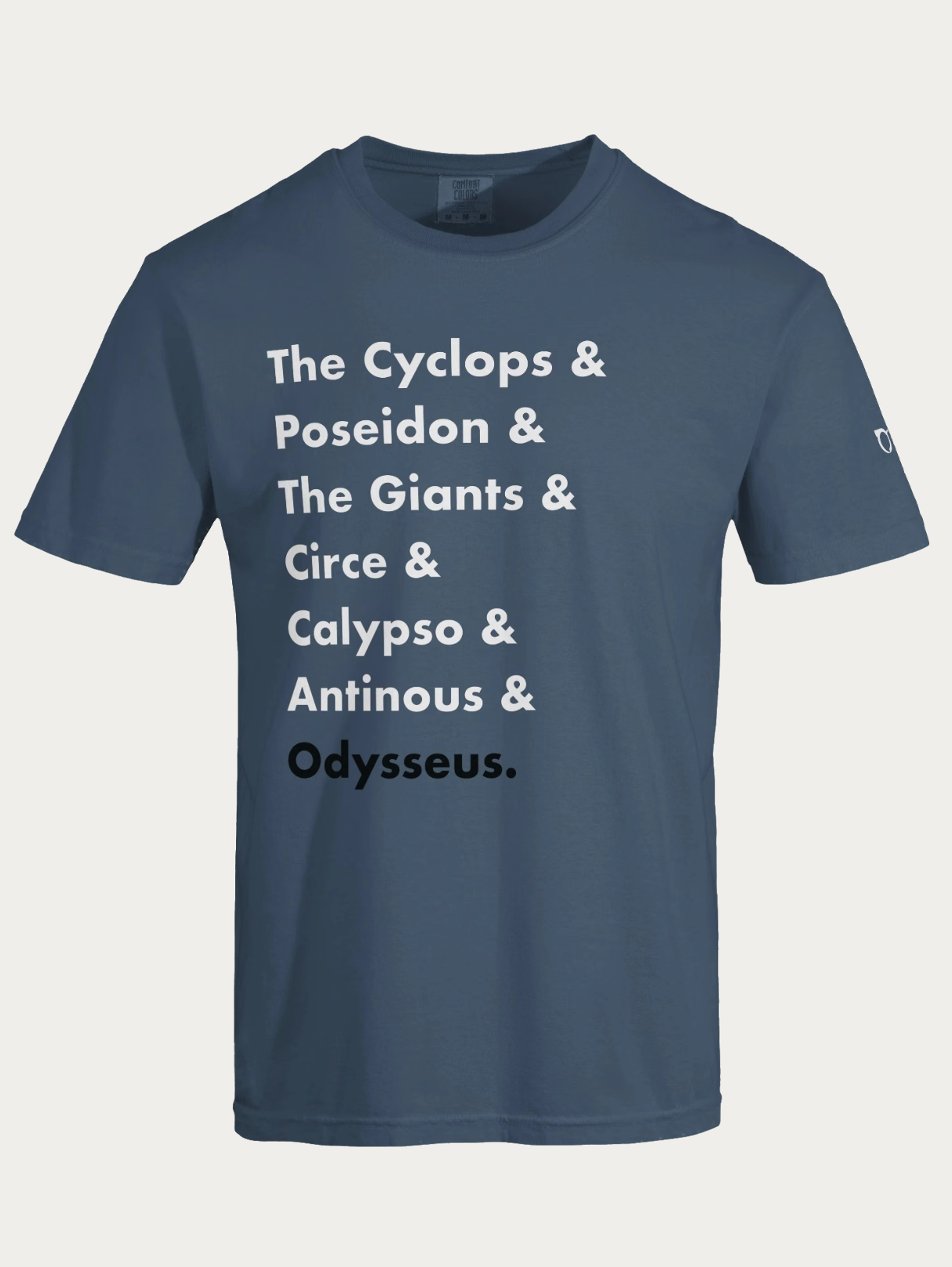
We just designed some new shirts based on some old designs of mine from college, featuring characters from the Odyssey and other epic poems, and another featuring political philosophers throughout history.
They make awesome gifts for any ancient-history-nerd in your life.
Nolan's Secret
This is Antinous's lottery token. And it might be the most mysterious — and important — object in The Odyssey. And big spoilers, of course, because it completely transforms the movie's meaning. You see, The Odyssey is a movie about guilt. And you'd think the Trojan Horse is it’s most important symbol. After all, this is what haunts Odysseus, his cl
ever lie that won the war but broke every sacred rule of fairness and doomed Greece to a dark age.
And that’s all true. But ask yourself, who actually delivered the Trojan Horse? Sinon. And how did he get there? This token.
Because ten years earlier, when the Trojan War got started, the men of Ithaca had to draw lots to see who would go to war, like a sort of ancient military draft. Draw one like this, and you’re in. But Sinon never drew one like this. He was never supposed to be on that beach outside Troy.
Antinous drew this lot. But he paid Sinon off to take his place. And when Odysseus saw it happen, he did nothing. Think about it — had it been Antinous, not Sinon, delivering the horse, maybe he would’ve been too clever or too selfish to see it through. Maybe everything would’ve turned out completely different.
Which actually makes this — not the Trojan Horse — Odysseus’s original crime against Greek rules of fairness.
And if that seems like a stretch, get this — there is no Sinon in the original Odyssey poem. Christopher Nolan actually wrote him in from a later Roman epic, the Aeneid. And he chose to call a lot of attention to him. He delivers the horse. He confronts Odysseus in Hades. And he commands Odysseus to go home, take revenge on Antinous, and return this, which Odysseus does in the climactic moment of the movie, stuffing it down Antinous’s throat.
So, let me put it this way. I think this is as central as the Trojan Horse, if not moreso, to Odysseus’s guilt. And violating the lottery is what really kickstarted Greece’s descent into a dark age.
And that’s so interesting, because it ties Nolan’s version of the story to very real and fascinating history. Because while the Trojan Horse may never have existed, lotteries like this really did. And they were so important to the Greeks, they didn’t just use them for military drafts. They used them to conduct religious ceremonies and distribute vital resources. They even believed that once upon a time the gods drew lots to divide rule over the world. [A, I.1]
And 700 years after a very real, historical dark age, lotteries like this ancient device were actually the key to reviving Greek civilization and bringing about a new golden age.
So to really understand what’s going on here with Antinous’s lottery token, and what it means in this story of civilizational collapse, we need to take a look at how the Greeks really used lottery, why it was so important to them, and how it helped them build one of the great epochs of human history.
This is the story of Ancient Greece’s most peculiar tool, and how it transforms what The Odyssey means to us today.
What Lottery Was
So, how did the Greeks actually use lottery?
Well, in the Iliad, Homer’s poem that precedes the Odyssey, Achilles and the other Greek warriors draw lots to decide who will duel Hector, the champion of Troy, while even the three most powerful gods of Olympus — Zeus, Hades, and Poseidon — draw lots to decide who will rule the heavens, the underworld, and the seas. [B, VII & XV]
And in The Odyssey, whenever Odysseus and his men gain some plunder, he distributes it amongst them so all get equal shares. When they escape the cyclops, for instance, with some of the creature’s sheep in tow, Odysseus distributes it to all his men in random, equal fashion: even to those who waited safely on the beach with the ships. [C, IX]
And outside literature, we have lots of real historical evidence that ancient Greeks used lottery systems to divide valuable resources like land, meat, and plunder, to divine the will of the gods and decide who could speak with their oracles, and even to select members of the public to lead in politics. [A, i]
In other words, the Greeks took lottery pretty far. But there’s a big caveat I have to point out here.
How Lottery Developed
In modern times, we really like to mix up “The Greeks.” The reality is that lottery reached its peak of popularity in the Classical Era. That’s the Greece you probably know best: Athens, Sparta, Socrates, and 300. And that’s where we see lottery even being used to assign political offices. But Homer composed his poems roughly 200 years before all that. And The Iliad and Odyssey take place 500 years still before him, in a time known as Mycenaean Greece: the Bronze Age*.*
And while we know very little about the culture of this period for mysterious reasons I’ll explain soon, these guys probably were not big on lotteries. Archaeology — and Homer — suggest this was a period of kings and warlords. That’s why you have guys like Odysseus with huge reserves of food that everybody depends on, because he’s the king and controls everything in Ithaca. And it’s why you’ve got this big dumb war against Troy started by Agamemnon and his angry cuckold brother Menelaus…because Agamemnon is the king of kings.
In turn, the Mycenaeans didn’t care much for equality. They probably didn’t distribute plunder equally or think of the divine realms as assigned randomly. This was a time of might makes right.
So lottery here is an artistic invention—used centuries later by Homer and millennia later by Nolan. But...why? First, Nolan can help us understand why Homer does it, and then we can decipher what Nolan himself is up to.
Our first big clue comes in the final words of Nolan’s Odyssey, when Odysseus laments that soon the Greeks will have no more writing, because the old world order is collapsing thanks to him. And, historically speaking, something like that really did happen. We know so little about Mycenaean Greece because at some point, that society did fall apart. Theories for this “Bronze Age Collapse” abound — sea peoples, massive migrations, climate change, a wave of volcanic eruptions, but nobody really knows.
The upshot, though, was that society did crumble, literacy did evaporate, and complex kingdoms gave way to small-scale, even tribal societies. Without one or a few highly entrenched elites like Odysseus or Agamemnon, politics became more egalitarian. And how, in the ancient world, with nothing but sticks and rocks at your disposal, do you guarantee equality when you’ve got valuable things like cuts of meat, land, or plunder to distribute? The same way you did as a child — you draw sticks.
How Athens Used Lottery
Now over the next few centuries, Greece did “bounce back” from the dark age, rediscover writing, and start living in more complex societies again. And as a result, the same sorts of inequality that defined Mycenaean Greece did begin to creep back in, as some entrenched their own wealth and power. So those tribal, egalitarian societies gave way once more to cities, where some embraced monarchy once again, others aristocracy.
But despite this, lottery remained deeply-engrained throughout Greek culture. And that’s why, as the Greeks rediscovered writing, we get Homer’s epics, and that’s why those poems are so infused with emphasis on lottery as a source of justice, and that’s why not every city turned its back on lottery.
In fact, there was one city that embraced it more than any other, a city that reached such heights they marked this period as not just an end to a dark age, but a new golden age altogether: Athens. And here, like in Nolan’s Odyssey, the disparity between the rich and the poor was essential to why they held onto lottery.
You see, early in this period of Greek revival, Athens fell into civil war between the rich and poor. To put a stop to it, a leader named Cleisthenes came up with this: the Athenian council. This was a board to govern the city, but it wasn’t elected or appointed or inherited. This was 500 people randomly selected by lottery from the citizen body to share power equally.
And it worked so well that over the next few decades, the Athenians expanded their use of lottery to all kinds of political offices. They established a legislature of 6,000 citizens, but the seats were filled by whoever got there first each day. They also used lottery to select juries for the city’s courts, not unlike our own courts today. Except in Athens, there were no judges: random citizens only. [D]
And instead of drawing sticks, they devised specialized devices like this one to conduct all these lotteries. Known as a kleroterion, citizens would inscribe their names and insert them for entrance into the lottery, and using mechanisms not unlike modern powerball rollers officials would draw names at random.
With these lotteries, Athens vaulted from being a relatively unimportant backwater to the nucleus of the Classical Greek Golden Age. It was the richest city in Greece, the capital of a vast naval empire, the home to monumental feats of architecture like the Parthenon, and the birthplace of drama, medicine, history, and philosophy, thanks to guys like Plato, Socrates, Aristotle, Diogenes, Euripides, Thucydides, and more. Practically everything we think of as the birth of Western civilization was actually born in a society defined by lottery.
So we know a few things so far. First, Odysseus doomed Greece to a dark age by subverting core Greek principles of reciprocity and fairness. He did this most famously with the Trojan Horse, but his real original sin — the one Nolan purposely inserted into the story — was actually a violation of the military lottery. And in the end, it’s this mistake that Odysseus atones for in the climax by killing Antinous, and it’s this institution — lottery, not Zeus’s law — that was actually politically and historically central in restoring Greece to a new Golden Age.
But how could that actually be true? How could people dig themselves out of a dark age, let alone achieve one of the great golden ages of human history, on the basis of something so crude as a random draw?
I’ll tell you how, but first one quick aside, and it’s not a sponsor message. You can probably tell I’m a huge nerd for Ancient Greece. Actually, we are. Spectacles is a two-man show I run with my best friend from college who I’ve argued with countless times about the meaning of The Iliad, The Odyssey, and Plato’s dialogues. When we were in college, I even made this tee shirt of political philosophers throughout history and this one, of the characters from Plato’s Symposium.
Every video we make is a deeply-felt passion project about stuff we sincerely care about, and it’s really gratifying to know there are so many people out there who feel the same way. But YouTube is harder than ever. It’s full of AI slop and advertiser spend is going down, and who knows where this platform — or we — will be a year from now.
So if you care, like we do, about stories that matter to democracy, consider joining the channel or our Patreon — we’ve got some very cheap tiers there. Or grab some of our merch like a coffee mug, poster, or even one of these tee shirts we put together, featuring characters from the Odyssey, other epic poems, or even one of my old designs from college.
Or you can always leave a one-time tip down below. And if you do any of those, thanks so much. And if you can’t or don’t, hey thanks for watching all the same.
But enough about that. I want to tell you how lottery could have possibly revived Greek civilization.
Why Lottery Works
And the answer is simply that lottery is secretly crazy-powerful. By producing a random representative sample of society, it leverages human psychology to produce a more intelligent and trustworthy politics that brings a community together rather than driving it apart. Let me explain.
First, the representative sample. Consider how elections work. Who’s likeliest to win? The wealthy, well-connected, or simply tall and beautiful. Who’s likeliest to want to campaign? The ambitious and self-obsessed. [D, ch. 2] What do you get? A system that represents a really narrow slice of the population. [D, ch. 3] Lotteries, on the other hand, give everyone an equal chance of selection, producing a representative sample of the society. In other words, more Sinons, fewer Antinouses and Agamemnons.
And that’s a good thing for a few reasons. First, being rich or sociable or beautiful has nothing to do with being wise or capable at governing a community. Second, that narrow slice of people is likely to end up thinking in narrow, similar ways, missing insights that might be obvious to people who don’t fit the mold of a politician. Groups of people who think about things in different ways tend to be more effective because they see things things their peers miss and tend to be more comprehensive in their explorations of solutions. [E, 2.6]
But this representation doesn’t just make politics smarter. It also makes politics more trustworthy. Remember, elections actually prioritize selfish and ambitious people. Meanwhile, lottery brings in ordinary people who will actually have to live with the consequences of their decisions, just like everybody else. And by considering everyone an equal participant expected to contribute to politics at the highest level, political education, awareness, and scrutiny of your neighbor’s actions is heightened. All of this increases accountability and reduces corruption.
And finally, lotteries bring people together. Elections force us to join our little political teams and cheer for each other’s defeat. In Athens, on the other hand, you had to work with randomly chosen people who had different ideas and come to compromises. With lottery, politics becomes less of an ideological contest and more of a mutual pursuit of solutions to shared problems. [F, 6, 8, 10]
What Lottery Means for Us
Now that’s a big set of claims, and while you can learn all about the cognitive science, game theory, and history that proves all of it in our longer video right here or in this great book by Helene Landemore, I can tell you right now that several countries have recently run experiments using Athens-inspired lottery systems and they’ve all discovered the exact same virtues.
In Iceland, a constitutional convention formed from random citizens cleverly solved longstanding political conundrums and received massive, unified public support. In France, another lottery-based constitutional convention brought the country back from the brink of violent rebellion and devised incredibly creative solutions to intractable political challenges, all while bringing people across a wide spectrum of political beliefs together. And lastly, in Ireland, lottery assemblies have crafted policies which have repeatedly found massive public support in referenda, on issues like gay marriage and abortion, long believed to be impossible issues in the deeply Catholic nation. [D, ch. 4]
The point is simple. The science is there, the history is there, the modern examples are there. The Greeks embraced lottery as a means of achieving equality, reciprocity, and fairness. And with this tool, they dug themselves out of a dark age caused by the instability of monarchs and warlords and built a golden age surpassed by few other epochs in human history. And today, the same ideas still work for the same reasons.
Lottery and Poetry
But I’ve gotten a little far afield from Nolan’s Odyssey. And yet in another sense, I haven’t.
Nolan placed lottery at the heart of Odysseus’s revelation, his violation of that sacred norm at the center of his guilt over Sinon’s death, and his correction of that mistake, his punishment of Antinous, and his returning of the shame at the pinnacle of the film’s climax, as he stuffs the token down the dying villain’s throat. And what’s even more compelling, he wrote all this stuff about lottery into the Odyssey’s story.
In the original poem, Antinous never drew a lot or exchanged it with Sinon. In fact, as I mentioned in the intro, there is no Sinon anywhere in the Odyssey. He only appears in the later Roman version of the story, the Aeneid.
So Nolan chose to insert lottery into the heart of this story, and funnily enough, this makes Nolan rather a lot like Homer himself, whose poems depict lotteries in a society which almost certainly never practiced them in the way he depicts. Yet there’s a crucial and telling difference between the two poets that completes our understanding of what this all means.
Remember, Homer inserted lotteries likely out of ignorance. They were a crucial institution in his time, and he probably simply assumed it was just as crucial centuries earlier, in the world of the Mycenaeans.
Nolan, on the other hand, is operating from a totally different social and political context. In our world, lotteries are completely alien. Unlike the Greeks, we reflexively define democracy as a society with elections, and odds are that you were inclined to write lotteries off as idiotic when this video started — or when you saw the movie.
With the Odyssey, Nolan isn’t merely projecting our modern ideas of justice and politics onto the past. Instead, he’s taken the ancient practice of lottery seriously: as a legitimate source of fairness and reciprocity which Odysseus ought to feel shame and guilt for violating. And by placing that violation at the center of a story of civilizational collapse, Nolan invites us to consider whether we still haven’t learned the lessons of the millennia-old song of Odysseus. Perhaps, in failing to rejuvenate that long-forgotten sacred institution, we still are living in the dark ages.
Post-roll
Hey, thanks for watching. Just a reminder that if you care about stories that matter to democracy, consider joining the channel or grabbing some merch, like our brand new one with characters from The Odyssey. Or, you know, just subscribe and watch another video.
Sources
A. Irad Malkin and Josine Blok. Drawing Lots: From Egalitarianism to Democracy in Ancient Greece. United States: Oxford University Press, 2024.
B. Homer. The Iliad.
C. Homer. The Odyssey.
D. Hélène Landemore. Politics without Politicians. Penguin, 2026.
E. Scott E Page. The Difference. Princeton, N.J. ; Woodstock: Princeton University Press, 2007.
F. Donald Kagan. The Fall of the Athenian Empire. Ithaca: Cornell University Press, 1992.

Comments
Join the conversation