

This episode is sponsored by Odoo.
Odoo is a powerful business software suite that combines 45 essential business apps in one place, so you can work smarter and faster. Every Odoo app integrates with the others, whether it's invoicing, accounting, inventory management, web hosting, document signing, or anything else. Odoo has you covered.
Your first app with Odoo is always free for life, but you can upgrade to the full suite for just $24.90 a month. Odoo will make your life much easier. So try it out at the link below.
Every signup supports our work.
In a closed-door meeting back in his first term, Donald Trump complained to his top staff that he needed more "German generals." When his Chief of Staff clarified, "Surely you don't mean Hitler's generals, sir," Trump replied, confidently, "Yeah, yeah, Hitler's generals... They were totally loyal." (B)
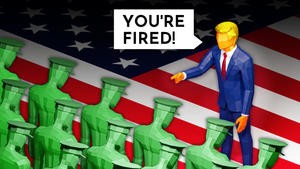
And now, 16 months into his second term, he's already fired nine four-star generals and admirals — America's top officers — and replaced them with handpicked successors. In the 160 years before he took office, American Presidents fired a total … of eleven. (C, 5 ✱)
Right now, Trump is getting his German generals using the same strategy Hitler used, and it’s all possible thanks to a fatal flaw in our Constitution.
I mean, the highest-ranking officers of the Navy, Coast Guard, Air Force, and Army have all been sacked. Trump says this is about undoing DEI and restoring meritocracy, but when he explained he likes his new pick for the highest military officer in the country, Dan Caine, Trump said it was because when they first met, Caine donned a MAGA hat and declared,
[Trump: “I love you, sir. I think you're great, sir. I'll kill for you, sir.”] (D)
Caine swears he never said this, but it doesn’t matter (E). This is Trump telling us what he cares about. And it isn’t competency. It’s loyalty.
That’s what drove Hitler to purge his rivals in the Nazi Party and then his own top generals, again and again, during the 1930s (F, 116-117). If the men with guns are personally loyal to you, you can hold on to power indefinitely.
Hitler understood that. And so does Trump.
It’s why he’s deployed the National Guard and Marines to American cities (G), why he tried to order the army to seize voting machines after he lost the 2020 election (A), and it’s why he’s firing all the military’s top officers and lawyers.
Once upon a time, this wouldn’t have been a big deal. We know that because America’s military has been purged before. Thomas Jefferson did the same thing, back in 1802 (H, Ch. 3). But back then, it didn’t matter, because America’s military was small, decentralized, and composed of ordinary citizens (F, 165-166, 169-171).
That was the Constitution’s solution to someone like Trump. Don’t prevent a political military; just prevent a powerful military. And that is the Constitution’s fatal flaw, because in the last 200 years, our military has become massive, centralized, and divorced from ordinary citizens.
So this is the story of how America sleepwalked into a military crisis. This is why Trump’s purges are so dangerous and what we can do about it.
Founding
A large, powerful military in the hands of one man. That is the crisis we’re in, and it’s the exact sort of tyranny the Constitution was designed to prevent.
Which is why it’s so surprising that the Constitution vested so much power over the military in one Commander-in-Chief: The President (I).
But the Constitution had some other tricks up its sleeve.
First, it divided the military between militias controlled by different states, and it gave Congress the power to declare war (K).
Second, the militias and military of the United States were composed of ordinary people, not full-time soldiers (F, 165, 169-171).
Third, this also meant that America’s standing military was necessarily very small (F, 196). Small too then was the danger of abuse of its power.
In other words, by naming the President — a political figure — Commander-in-Chief, the Constitution did leave the door to a politicized military wide open from the start, in part because taking control of the military away from political leaders would mean taking it away from the citizens they represented. But because those leaders might abuse that power, the Constitution tried to mitigate the consequences of politicization with a small, citizen-based, decentralized military.
The Constitution’s solution was, in effect, to render the military weak, divided, and disorderly.
But what would happen if the country needed a bigger military, a more organized military, a more competent and professional military?
Civil War
Just sixty years later, many of those fears came true when America was torn apart by the Civil War. The military exploded in size, wielding sophisticated and devastating equipment such as artillery and repeating rifles (M, 88-89). At the same time, power over it concentrated under President Lincoln (M, 65-67).
And during and after the war, this awesome power was quickly put to use in Reconstruction: a long-term military occupation of the south which ruthlessly restructured society and politics to enforce racial equality (M, 78-85).
So instead of demobilizing at the war’s end, America, for the first time ever, hosted a huge peacetime standing army (M, 64). Now, its mission was unambiguously righteous. But there was just one problem.
Lincoln, that unambiguously righteous leader, was assassinated in 1865, just as the war ended. In his place rose his Vice President, Andrew Johnson: a Southern Democrat, the party of slavery and secession. Lincoln had run with him in order to signal a desire for reconciliation, but now it was Johnson who wielded the immense power Lincoln had assembled.
Over the next few years Johnson set to work attempting to turn those powers to his ends. In 1867, he branded Congress an illegitimate body because the South was excluded, stoking fears that he might turn the military on lawmakers (M, 73). Shortly thereafter, he fired a general in Louisiana and replaced him with a political ally (M,74-75). Then, he fired Lincoln’s Secretary of War, Edwin Stanton, and promoted Ulysses S. Grant to the post, hoping Grant would bring him the loyalty of the military (M, 75-76).
Yet Johnson’s efforts were ultimately foiled. Congress didn’t take these actions lying down, sticking to their reconstruction agenda. And Grant, rather than submitting to Johnson’s partisan ambitions, backed Congress as they forcibly reappointed Stanton to his post (M, 75-76). Any hope of deploying this enormous military against Congress lay beyond Johnson's reach.
In short, under Lincoln, the military had grown massively, and power over it had become dangerously centralized. For a time, the country was saved only by Lincoln’s unique virtue. But when he was replaced by a lesser man, these powers proved dangerous.
Luckily, though, not all the safeguards had been eroded. Power wasn’t totally centralized, as Congress checked the President’s ambitions supported by Grant, a professional — not political — general. And though it had grown, the military remained composed almost entirely of citizen soldiers: men who wanted no career in endless conflict or to launch a coup on behalf of the Commander-in-Chief.
In the end, America escaped Johnson’s administration just by the skin of its teeth. But the stage was set for something truly dangerous.
Imperial Wars
By the 1870s, white Americans tired of radical reconstruction, and the Union Army was demobilized…mostly (M, 81). That unprecedented peacetime standing army and navy shrank, but it didn’t go away. American soldiers were no longer regular citizens serving in emergencies. They were now full-time, totally removed from ordinary life.
On the one hand, demobilization was progress — a step away from the brink. Yet on the other, a new standing military still proved dangerous, and demobilization had destroyed any hopes of building racial equality in the South. With the troops gone, Jim Crow swept in to restore White supremacy (M, 81).
Yet there were other improvements. Unlike Generals Grant and William T. Sherman, much of the Union’s officer corps were still political appointees. On top of general incompetency, their loyalty was dubious: potentially lying more with political allies than the Constitution. So America reformed its military education. By 1898, 80% of Army officers were graduates of West Point military academy (F, 245). The Navy professionalized even faster.
This was another step in the right direction, but professionalism also came with a parallel development: centralization. After a bunch of states seceded and plunged the nation into civil war, many Americans had grown understandably skeptical of reserving so much power to state militias. So in 1903, they were replaced by a National Guard under greater federal control (F, 170).
It wasn’t long before this “improvement” revealed its danger. Presidents quickly deployed the new standing Army and National Guard to crush workers' protests against industrialization (M 83), to complete the centuries-long genocide of Native Americans (M, 60-63, 85-87), and to invade and pillage countries across Central and South America (M, 91-94). And in the face of each, Congress did nothing, allowing that such actions somehow fell under the President's Commander-in-chief authorities (O).
Within about 100 years of the founding, America’s military had become just what the founders had feared. The military had grown dramatically. Many soldiers were now full-time, not conscripted: a rank-and-file potentially more loyal to the top brass than the public good. And control over it had consolidated in the Presidency, nearly unchecked by a do-nothing Congress.
In turn, that military proved a menace to the rights of citizens at home, the treaty-rights of our neighbors, and the general welfare of civilians abroad.
World War 1
But then, something happened.
In 1914, a world war erupted between the major powers of Europe and, by extension, their global empires. America, too, was eventually drawn into the fight, and it was brutal. The Civil War had brought artillery and repeating rifles, but now war meant machine guns, tanks, bigger artillery, toxic gases, global plagues, and more.
It was so bad that many believed it would be the war to end all wars. Americans had seen, felt, and now bore the scars of modern trench warfare. They were no longer immune to the consequences of the reckless militarism which had grown up in the pre-war period.
So instead of war, America now sought peace. President Woodrow Wilson went to Europe with fourteen ideas to reduce arms production and adjudicate global disputes peacefully. Though Europe preferred revenge, in Washington nearly everyone was now anti-war (F, 289 ).
So over the next 15 years America wound down its international expeditions, shrank its military, and started orchestrating and signing all kinds of arms control agreements with countries all over the world, like the Washington Naval treaty, Geneva Protocol, and London Naval Treaty (N, 28-29). Congress, too, got more serious about its authorities, because America had one objective: no more world wars.
World War 2
That didn’t quite work out.
This was now World War II, and it was no time for a small or decentralized military.
Almost overnight, America’s military exploded in size, thanks in large part to citizen conscription. By 1945, more than 10 million Americans were drafted into service. Draftees accounted for two-thirds of all American soldiers (M, 117).
In turn, though this military was massive, ordinary citizens were its core and soul. For them needless bloodshed was anathema, and slogans about licking fascists and saving democracy really meant something.
But when the war ended, that mission didn’t. Though Japan and Germany had been destroyed, the Soviet Union was stronger than ever, and to many Americans Communism appeared as great a threat to democracy as fascism. So something changed.
After World War One, the citizen soldiers went home. The military downsized. And America tried to convince the world to disarm and go to peace. Because the war had been a horror.
But World War Two wasn’t a horror — at least, not for Americans. Europe was desolate, but the American mainland was untouched. We lost comparatively few soldiers. Our industry was unmatched, and we held new weapons of Biblical power. For Americans, the war had been a righteous crusade, and victory was sweet. So a new idealism arose. This time, it wasn’t about disarmament. It was about continuing the crusade.
So that massive, part-time, citizen military transformed into a standing force deployed permanently across a global network of military bases (N, 162-164).
Yet underneath this idealism, there were darker currents. Remember the Civil War. An expanded, more centralized military had remained virtuous on account of its citizen composition and the virtue of its leader. Yet that virtue quickly faded as the military became permanent and its leadership lost touch. In turn, wicked brutality and abuse followed. A brush with horror in World War One had led to a correction. But just decades later America was now once again enlarging its military and abandoning the part-time citizen soldier.
And now that military also had tanks, bombers, aircraft carriers, submarines, jets, and nuclear bombs. Further still, at this same time, the armed forces were becoming more centralized than ever. A new Defense Department combined administration of all the different branches into one body under the President. And Congress, though assertive between the two world wars, was about to surrender its power completely (M, 108-110).
Cold War
First, in 1950 Harry Truman went to war in Korea. He labeled it a “police action” on behalf of the United Nations. Congress never declared war (O).
Then, in 1964 Lyndon Johnson went to war in Vietnam. Congress never declared war, but they did pass a law to institute a draft (M, 133-136). On the one hand, this was simply evil. Nearly two million ordinary Americans were forced to fight in a war they hadn’t asked for, which was being waged in utter violation of the Constitutional order.
Yet on the other hand, the draft proved a nightmare for those seeking to wage the war. Low morale and insubordination caused constant problems and contributed to America’s eventual defeat and withdrawal.
Since then, America has never seen a draft. No longer is the question “Will I or my loved ones have to fight in this war?” on the minds of every American voter. In turn, war has become politically cheap, and the track record shows it.
In 2001, George Bush went to war in Afghanistan. In 2002, Yemen and the Philippines. In 2003, Iraq. In 2004, Pakistan. In 2007, Somalia. In 2011, Barack Obama went to war in Libya and Uganda. In 2013, Niger. In 2014, Iraq, again. In 2014, Syria. In 2015, Yemen, again. In 2015, Libya, again. And in 2026, Donald Trump went to war in Iran (O).
Congress never declared war once. In fact, the last time they did was in World War II (O).
Dangerously enlarged, the American military has become a tool of unparalleled power… and destruction. Unmoored from its citizen basis, it no longer possesses a soul with any attachment to a sense of public good or democratic values: more comfortable at war than at peace. And concentrated in the office of the president, it is now easier than ever for one man to wield with utter abandon.
All three of the safeguards built in by the founders have faded away. Yet one safeguard has remained intact which the founders never intended: professionalism. After the Civil War, America abandoned officer appointments by political favor in favor of an educated, professional officer corps loyal, above all, to the Constitution. Since then, a political officer corps has all but disappeared.
Present
That is, until now.
Upon taking office Donald Trump hired Pete Hegseth as his Secretary of Defense, a man who spent more time at Fox News than in the military, who's settled out of court over accusations of rape, embezzlement, and workplace drunkenness, and whose own mother described him as a serial abuser. (P, Q)
Now, to Trump that may reflect a professionalism of some sort.
[”It’s just locker room talk.”]
But when it comes to competency, cool-headedness, and devotion to a Constitution and bill of rights, Hegseth hasn’t got it. But he has got loyalty, just like Trump’s new Chairman of the Joint Chiefs of Staff, Dan Caine.
[”I’ll kill for you, sir.”]
Hegseth’s office may usually be a political appointment, but that doesn’t explain Caine’s selection. The Joint Chief is the top uniformed officer in the country; a selection based on political loyalty is extremely unusual. And remember, in Donald Trump’s second term, he’s fired nearly as many generals as were fired in the hundred-and-sixty years before he took office.
Among those fired were the Chief of Staff and Vice Chief of the Army and the Air Force, the branches’ highest-ranking officers; the Commandant of the Coast Guard and Chief of Operations of the Navy, those branches’ highest-ranking officers; the director of Army Transformation; and the director of the National Security Agency and Army Cyber Command (C). By the way, that last guy was fired because Laura Loomer complained about him being disloyal (S). His replacement at the NSA and Cyber Command is a guy who has zero prior experience in cyber affairs.
Now, if Trump had other good reasons to fire any of these people — the highest-ranking officers of several branches — we wouldn’t know because he’s routinely refused to justify his actions.
And it doesn’t end there. Judge Advocate Generals, the lawyers charged with determining the legality of military decisions, have also been fired at an unprecedented rate, many after raising legal objections to the administration’s actions: also known as…doing their jobs (T).
Nor is this new for Trump. Back in his first term, after he lost the 2020 election, Trump literally drafted an executive order for the military to seize voting machines and voter rolls. While the order never went out, he’s said he regrets never issuing it (A). And in this term, he has deployed the National Guard and Marines to American cities (U).
Trump's own rhetoric leaves little doubt as to what he he wants to use the military for. He’s openly mused about invoking the 1807 Insurrection Act to deploy troops to shoot protestors. In his first term, he complained to his Chief of Staff, former General John Kelly, that his generals weren’t as loyal as Hitler’s and called them “a bunch of pussies.” All this from a man who in 1997 said his “personal Vietnam” was avoiding STDs (V).
Conclusion:
If the military were the size it was under Thomas Jefferson, this politicization would be less concerning. If state governors had the authority to resist the president assuming control of the National Guard, it would be less concerning. If Congress were willing to stand up and do anything about Trump’s purges, it would be less concerning.
But over the last 250 years, America built the most powerful army the world has ever seen, and entrusted its function to one man. And now, it just so happens that that one man is unhinged, contemptuous of the Constitution, and hungry for personal loyalty above all else.
In the face of all this, there’s a temptation to say we should go back to the founders’ original vision: to downsize, to decentralize, and to return to part-time citizen-soldiering. But we need to be clear-sighted about this. This unusual system worked thanks to America's favorable geography and the simplicity of colonial-era military technology. But the industrialized, globalized world blunts our geographic advantages and demands technical expertise across all domains of war. Today's "minuteman" is not a citizen waiting with his musket to be called up in a time of need; it's literally an intercontinental ballistic missile.
Between size, conscription, and decentralization, the one most fixable is probably decentralization. While a return to state militias is out of the question, the Constitution also intended to separate war powers between the President and Congress. After the Civil War, when Andrew Johnson plunged America into a near-crisis over military appointments and politicization, it was Congress that stood up, reined him in, and righted the ship. It’s easy to imagine how it could do something similar today. Congress could reassert its constitutional authority over the armed forces, enforce a clearer line between war and peace, and use its oversight powers to publicize and condemn any attempts to inject politics into the officer corps.
But the window for this opportunity is closing. Today’s officer corps remains largely professional and loyal to the Constitution, not the President. But the more generals Trump replaces, the deeper he forces his cult of personality into the structure of our military, the more difficult reining him in will become.
Sources
✱ — This also includes five-star generals, as this is a rare wartime promotion. We believe Douglas MacArthur, fired by Harry Truman, is the only one here, but we wanted to be thorough and note the exception to the “four-star generals” who have been fired.
A. Alan Feuer and Ashley An, “Trump Regrets Not Seizing Voting Machines After 2020 Election,” in The New York Times, 11 January 2026.
B. Jeffrey Goldberg, “Trump: ‘I Need the Kind of Generals That Hitler Had,’” in The Atlantic, 22 October 2024.
C. Michael Cembalest, “Eye on the Market,” JP Morgan 2026 Energy Paper, 6 April 2026.
D. Donald J. Trump, “Former President Trump Speaks at CPAC,” on C-SPAN, 24 February 2024.
E. Eleanor Watson, “President Trump's nominee for top U.S. general says he never wore a MAGA hat,” 1 April 2025.
F. Samuel Huntington, The Soldier and the State: The Theory and Politics of Civil–Military Relations, (Harvard University Press, 1959).
G. Lawfare, “Tracking Domestic Deployments of the U.S. Military,” last updated 13 May 2026.
H. Brad D. Lookingbill, The American Military: A Narrative History (Wiley Blackwell, 2013).
I. US Constitution, Article 2, Section 2.
J. Publius, Federalist no. 70.
K. US Constitution, Article 1, Section 8.
L. Military Peace Establishment Act of 1802.
M. Kori Schake, The State and the Soldier (Polity Press, 2025).
N. Stephen Wertheim, Tomorrow, the World (Harvard University Press, 2020).
O. Wikipedia, “Undeclared Wars of the United Sates.”
P. “Text of the Email That Pete Hegseth’s Mother Sent Him,” in The New York Times, 29 November 2024.
Q. Maggie Haberman, “Trump’s Pick for Pentagon Paid an Accuser but Denies It Was Sexual Assault,” in The New York Times, 16 November 2024.
R. Helene Cooper and Eric Schmitt, “Dan Caine, Trump’s Joint Chiefs Pick, Had Unusual Path to Top Ranks,” in The New York Times, 21 February 2025.
S. Will Steakin and Katherine Faulders, “Loomer, far-right activist, urged Trump to remove NSA director and others: Sources,” ABC, 4 April 2025.
T. Natasha Bertrans, “How the Pentagon sidelined lawyers while testing the legal limits of military action,” CNN, 16 October 2025.
U. Mikhail Zinshteyn, “5 things to know as Newsom and Trump go back to court over the National Guard in LA,” CalMatters, 11 August 2025.
V. Tessa Berenson, “Donald Trump Says He Always Wanted A Purple Heart,” Vanity Fair, 2 August 2016.

Comments
Join the conversation