
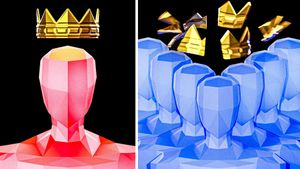
Switzerland has seven presidents at the same time, and it's genius.
Introduction
This is the president of Switzerland. It’s seven people. Seriously. And they’re from four different political parties: right-wing populists, left-wing socialists, liberals, and centrists, who all have to agree for anything to get done.
It couldn’t be more different than America’s single president: one man with immense power over a massive bureaucracy and military to do with as he wishes, when he wishes.
So which works? One way to tell would be imitation. Both systems are over a century old. Have either of them been copied by other countries?
America’s presidential system has been copied almost countless times: Mexico, Brazil, Argentina, Colombia, Venezuela, Chile, Peru, Bolivia, the Philippines, South Korea, the list goes on. (C)
Except…there’s a problem. Every single one of those countries, including America, has seen a President plunge the nation into a political crisis — usually, because he sought to block elections or seize dictatorial powers. Often, he succeeded. (fA)
The Swiss multi-presidency, meanwhile, has been copied only twice: by Bosnia-Herzegovina and Northern Ireland. Yet Switzerland has been maybe the most stable and peaceful country in the world over the last 150 years.
You might think that’s because of Switzerland’s mountainous borders. But that doesn’t explain why it’s been so internally, politically stable.
That’s because this is about concentrating power, and this is about sharing it.
Maybe you think that sounds silly. America is a diverse country where someone needs to show leadership to get us to work together, while Switzerland is homogeneous and united. Sharing power is easy when everyone already trusts each other.
Except, that’s just not true. Switzerland is anything but homogeneous. They have four official languages and a society split between Catholic and Protestant, between German, French, and Italian-speaking communities once so divided that they nearly tore their country apart in a civil war. (A, 2.1)
This system isn’t the product of peace and cohesion. It’s the product of war and division, and it has given Switzerland peace and cohesion, by using three genius ideas: Zauberformel, Concordance, and Votazione.
That’s why it was copied in the 90s in Bosnia-Herzegovina and Northern Ireland: two societies ripped apart by cultural division and civil war. And in both places, the Swiss system has been essential to maintaining peace.
And it may just give us a blueprint for mending divided societies everywhere, including America.
Along the way, I’ll be honest about the serious challenges the Swiss system faces. How do they get anything done? Why do the Swiss vote on six constitutional amendments every year? And what can America — a country already drowning in vetoes, stagnation, and divisions of power — possibly stand to gain from dividing power even more?
So, this is why Switzerland has seven presidents at once and why this apparently insane idea may just be genius, after all.
Zauberformel
In Switzerland, no one wins an election. No one party gets a majority of seats in the legislature, and no one party gets the presidency.
The biggest party in Switzerland today has just a quarter of the vote. (E) Instead of a governing majority, parties compete for a slice of the electoral pie, for one or more of the seven seats at the presidential table, to negotiate policy with the other parties.
It may seem strange that no one party can win majority support, run the government, and deliver on their promises to voters.
However, if you ask a Swiss person, they’ll happily tell you this is their zauberformel, their magic formula. (A, 5.1) Elections aren’t about political factions fighting for power; they’re about representing the public’s diverse perspectives in government, where they can be negotiated productively.
And the Swiss do this for two big reasons: a violent past and a crucial dilemma.
You see, Switzerland learned the hard way what happens without the power-sharing zauberformel.
Back in the 1800s, when Switzerland was less a country and more a loose-knit alliance of communities known as cantons, the region was engulfed in civil war. German Protestants invaded French and Italian Catholic cantons, forcing them to join together in a united democracy. (A, 2.2)
But the problem, for the Catholics, was simple. German Protestants formed a solid majority in Switzerland. Majority rule just meant majority dictatorship. (A, 2.3)
So the Swiss Constitution struck a compromise. Borrowing from the American playbook, it created a federal system, where the cantons, like American states, would hold onto significant power, protecting smaller Catholic communities from total domination. (A, 2.3)
This is the violent past, but Switzerland hadn’t yet developed the magic formula, because there was still one big problem.
The Swiss constitution also copied America’s election system, which was copied from Britain: a society nothing like Switzerland. You see, Britain developed an election system designed to give one party control of the entire government.
In a homogeneous country like Britain, that's ok, because political competition is based on ideas, not identities. And over time, majorities shift, power changes hands, because ideas change. A young progressive might become conservative as they age.
But identities don’t change. A French Catholic isn't going to become a German Protestant. With these sorts of elections, a minority group will be perpetually shut out of power. (A, 2.3)
This was the crucial dilemma.
And it proved true. For decades, one German Protestant party ran the Swiss government alone.
But that changed in 1919, when Switzerland replaced the British voting system with something invented in the small Italian-speaking canton of Ticino: proportional elections. (A, 2.6)
This system awards seats in the legislature and presidential council to parties, according to the percentage of votes they capture. As a result, many parties can compete, instead of just one or two.
And with one small exception, since 1959 the same four parties have held those seven presidential seats, 2-2-2-1. That is the zauberformel, the magic formula. (A, 5.1) In turn, the presidency doesn’t just represent the interests of the biggest community in Switzerland. Instead four leading parties span the gamut, culturally and ideologically, and together they negotiate policy to not just satisfy a bare majority but to accommodate, more or less, the whole society.
Since the Swiss invented them, multiparty elections have spread all over the world, and they’ve become especially popular in the constitutions of new democracies in multiethnic societies. It’s the kind of innovation that we didn’t have when democracy was first invented, but if we were rebuilding society today, I’d say, go for it. It can be easy to think the way we live now is the way to live, to forget how many incredible inventions came along over centuries to make life the way we know it today.
Which is why I love “The Book: The Ultimate Guide to Rebuilding a Civilization.” And I love it so much, I actually reached out to them, and they agreed to sponsor this video, because it is genuinely so cool.
It’s got over 400 pages full of beautiful hand-drawn illustrations by dozens of real, human artists—which is rarer than ever—that detail nearly 200 of the most important inventions, innovations, and ideas that define our world. Here’s the spread on gunpowder, which also explains how to make it. The section on sewing machines helped me understand how they actually work, which I always wondered about. These illustrations for crop rotation are just…so cool. And there’s so much I didn’t know in this section on penicillin.
Whether it’s history, science, art, engineering, design, or something else, each turn of a page in The Book feels like such a cool adventure. The paper is heavy and feels so nice. The illustrations are gorgeous and exciting. And every spread is full of interesting information.
But I have to be careful not to spoil too much, because there’s actually a cryptic puzzle hidden across The Book’s beautiful illustrations. And it’s so tricky, I haven’t even solved it. In fact, only seven people ever have. Maybe you could be the eighth.
I genuinely love The Book, and I think anyone who enjoys these videos would have a great time with it. So whether you wanna check it out for yourself or grab a gift for a curious friend or loved one, visit spectacles.link/thebook and use code SPECTACLES10 for an exclusive 10% off discount. Every purchase helps the channel, too, and that link is also down below. And if you grab it, let us know in the comments what your favorite section is.
So, we were just wrapping up on why the Swiss have multiparty elections and why, while it may seem crazy, they call this their zauberformel, or magic formula. The magic, really, lies in this system’s ability to give everyone some of what they want and nobody everything. (A, 5.3)
While it may seem crazy that no one party can win an election, for the Swiss, the zauberformel’s magic lies in its ability to give everyone some of what they want and nobody everything. (A, 5.3)
Concordance
But of course, that requires constant negotiation amongst a grand coalition of opposing political parties. So how in the world could that actually function? Literally, how do they get anything done?
The answer is concordance, or as the French call it, concordance. (A, 5.1)
It’s a three-step procedure—draft, circulation, and consultation (my favorite part)—that, put together, builds consensus over policy across Swiss society.
Step one is the draft. Typically, laws in Switzerland are drafted here in the Federal Council — that is, by one of Switzerland’s seven executives. You see, the seven Swiss presidents are actually each in charge of specific departments — finance, defense, foreign affairs, etc. Whoever heads the relevant department is responsible for drafting the law. So a bill about a new tax or import duty would be drafted by the head of the finance department.
Then draft bills are circulated to the six other members of the Federal Council for comment and feedback. This allows the bill to be revised, synthesizing diverse perspectives across Switzerland’s political landscape and hopefully showing the path to a middle-ground.
Finally, there’s step three, my favorite: the consultation. Once a draft is ready for more serious consideration, the council shares it with the public, inviting affected citizens, interest groups, and organizations to provide feedback on the proposal. For example, for a policy regarding healthcare, the Council may invite academic experts in healthcare policy, as well as hospital bosses, insurance representatives, doctors, and even ordinary patients. And besides those asked for input, anyone in Switzerland can review the bill and weigh in.
The point of concordance isn’t just to collect data points to triangulate the best or most rational or most ideal policy according to experts. The point is to figure out what sort of policy the various stakeholders who would be affected are ready to abide by, before legislation ever faces a vote in the legislature.
Now, I know what you’re thinking; this sounds like a painfully bloated and slow process.
And honestly, that’s right. It’s so slow, it took until 1971 before women had the right to vote in Swiss federal elections. And some small cantons held out until literally 1990. Gay marriage was only legalized in 2022.
Yet the Swiss have good reason to take things slowly.
The main way big progressive change happens in two-party systems like Britain or America is that righteous but controversial policies get bundled with more popular bread-and-butter promises that a party can really campaign on. Then, once that party wins, they can claim a mandate to do all they promised, including the less popular items, even if most of their votes came in spite of that issue, rather than because of it.(A, 5.4)
You can sort of think of it like sneaking some medicine in with the candy.
Except, that is as dangerous as it is desirable. Parties can just as easily bundle unpopular and un-righteous ideas into their platforms and claim a mandate just the same.
Or, just as often in America, the major parties can agree just not to touch an issue legislatively. They may campaign on it year after year, but they never do anything about it, instead leaving it up to, say, the courts. That's what happened with the legalization of abortion or gay marriage: one of which was simply overturned recently and the other may follow—who knows.
Progress in a majoritarian system can come faster. Maybe that’s desirable. But it often comes as sleight of hand, not of democratic consent. Moreover, the same tool can be used just as easily for regression, and progress, if it does come, is often not lasting.
In Switzerland, change may be slower but it’s solid. It only happens when a new idea can make it through a gauntlet of tough negotiations between diverse parties and perspectives. So when it finally breaks through, it has a real foundation. (A, 5.4)
That’s why it took until 1971 for federal women’s suffrage. Yet already by 1984, one of the country’s seven presidents was a woman. By 2010 for some time, women held the majority of the seven presidencies. (A, 2.6)
And that’s why the Swiss don’t waste their time flip-flopping around. It’s why they invest so much time in building concordance and call their system a magic formula because this political solidity inspires trust and confidence which has been huge for Switzerland’s stability and prosperity.
Votazione
And though they may be slow, Swiss politics aren’t static. In fact, Swiss citizens vote, on average, on six constitutional amendments every year. (A, 2.1) I know, it sounds crazy, but it’s actually crucial to making the whole thing work.
This is Switzerland’s most crucial ingredient: votazione or votation. Because, though I explained the steps in concordance, you may still be wondering why all these different parties actually come to the table.
How does this avoid total gridlock? Why cooperate at all? And how do the Swiss, without more decisive elections, hold these politicians accountable?
The answer is Votazione. Not a vote, not an election, votation is what the Swiss call referenda, when the entire public casts ballots on individual legislative questions.
We actually have these in most states in America. Usually we call them “ballot initiatives.” But the Swiss do them bigger—across the whole country—and they do them better.
There are three kinds of Votazione: public initiative, optional referendum, and obligatory referendum. (A, 4.2)
Public initiatives allow 100,000 Swiss citizens to directly propose legislation to the government, bypassing the usual concordance process altogether. Then, the government forms a position on the question, maybe an alternative proposal, and they are put to a Votazione. (A, 4.2) The government cannot stop the vote, no matter how absurd.
In 1989, an initiative forced the Swiss to a votazione on whether they should abolish their army. It did not pass. (A, 4.1)
This keeps the government accountable and responsive. There’s no issue politicians can hide away in a corner and agree not to touch. If it’s popular, the people can always do something about it.
Then there’s the optional referendum. This happens when the concordance procedure is ignored or simply falls short. Any new law can be forced to a votazione by 50,000 Swiss petitioners. Fail to achieve majority support, and the law is killed. No backroom deals, and no defecting from the cooperative process. Work together, find real consensus, or the voters will simply shoot the law down. (A, 4.2)
And finally there’s the obligatory referendum. According to Switzerland’s Constitution, any power not explicitly given to the federal government must be approved in a votation by the public. (A, 4.2)
In one case, the entire country had to vote on whether the federal government could subsidize hiking trails…because that wasn’t in the constitution. (A, 3.1) That is why they vote on six constitutional amendments every year.
The Federalism Caveat
Maybe that sounds annoying. Maybe that sounds great. The accountability and popular influence over the government’s agenda have real virtues that inhibit corruption and backroom dealing.
But there’s a big caveat here. It isn’t just the people that count in the votazione.
Because remember, Switzerland is a federal system, and one of the reasons giving the federal government more power is so difficult isn’t just to protect individual citizens. It’s to protect the cantons: Switzerland’s states.
Which is why the obligatory referendum and public initiative require a majority of citizens and a majority of cantons to pass. (A, 4.2) That means one citizen from Uri can outweigh 35 from Zurich. (A, 3.5) And with how the Swiss count the cantons — some have two votes, some have one — that means 20% of voters can theoretically shoot down practically anything. (A, 3.2)
And it’s not just theory. Remember, these cantons are representative of actually divergent cultural communities that still exhibit major differences today. That 20% figure: it’s proven a real obstacle many times in Swiss history. It’s a big reason why women’s suffrage, for example, took until 1971.
Is It Unrepresentative?
So here’s the other big challenge for the Swiss system. How is this actually democratic?
It sounds quite like America, where a voter in Wyoming counts the same as 70 Californians in the Senate. We have a filibuster that allows 30% of voters to blockade practically any political action. We have a Constitution that is mind-numbingly difficult to amend and a political system so chock-full of divisions of power and veto points that it can feel like the last time Congress actually did anything was 10, 15, 20 years ago.
And it’s true. The Swiss system isn’t perfectly democratic. Any federal system sacrifices the principle of one-person, one-vote to some extent, because in some societies, that would just spell majority dictatorship. But what the Swiss system has going for it is that though it may be slow, it may be conservative, it may have its flaws, it is functioning.
The Swiss system was never designed to be fast. It was designed to be solid. It wasn’t designed to steamroll diverse cultural groups or crown a winner among them but to mediate and negotiate their differences to keep the fragile idea of Switzerland alive.
And we should pay attention to it, because the Swiss took their early cues from America. Because the American system was designed with the exact same intentions, and since the founding America has only grown more diverse and more heterogeneous. In turn, we haven’t just slowed down. We’ve become dysfunctional. Our politics are deeply polarized. Many minority groups are perpetually shut out of politics. The system is not negotiating our differences. It’s freezing under pressure and delegating more and more power to one individual, one president, with an increasingly dubious mandate.
And that has happened because the American system was highly experimental. Federalism was essentially a new idea. Separation of powers and checks and balances were essentially untested. And these were, and are, incredible innovations on the British model for a larger, more diverse society.
But the founders had their shortcomings. Besides condemnable concessions like slavery, they also simply couldn’t have figured everything out.
But luckily, the Swiss were willing to carry the torch. And instead of stopping at federalism, a rigid constitution, and separations of powers, they went further. They divided the executive into seven people to prevent ambitious mandates. They made their elections proportional to allow many parties to compete, ensuring perpetual minorities weren’t perpetually shut out of power.
They invented a magic formula to share that power. They designed systems that produced concordance. And they built votations to keep politicians collaborative, accountable, and honest.
In many ways, Switzerland is incredibly strange. In others it’s incredibly familiar. It’s like a bizarro United States. Yet those bizarro features are really just evolutionary applications of American principles, and they work remarkably well.
Conclusion
But that isn’t to say they’re not without shortcomings.
Federalism is easy to practice when you’re isolated up in the mountains and can tend to your own affairs. As Switzerland becomes more enmeshed in European systems and global trade, anger is growing as many cantons feel they’re losing a grip on powers and cultural habits they once held. How can a small canton support its historic dairy industry, when cheaper milk and cheese come flowing in from France, for example? (A, 5.5)
The brilliant zauberformel too has been shaken lately. It’s apportioned seats 2-2-2-1 to the same four parties since 1959 with only one brief interruption. That was from 2008-2016, when the legislature refused to give a seat to the figurehead of the right-populist SVP. The SVP got their two seats, but without this guy on the presidential council, the party declared opposition, refusing to cooperate in the grand coalition. But Switzerland’s magic formula is that everybody gets something, nobody gets everything. Choose not to participate…and you get nothing. So the SVP's opposition was functionally over within a year. By 2016, the party dropped the pretense completely. (A, 5.5)
That is how Switzerland, despite this hiccup, has successfully metabolized and integrated a large right-wing populist movement—a worldwide phenomenon which was actually born there—without it wrecking the country’s politics, as it has many others’.
In the words of Guy Parmelin, SVP member and current chair of the Federal Council,
In Switzerland, we have a unique political system with a government that enjoys very broad support. Before and during a Federal Council meeting, we each express our own points of view. But once the Federal Council has taken a decision as a body, we all stand behind it – collegially and loyally. (B, 53)
That ability—to take big divisive forces and rein them in, not to eliminate or silence them but to redirect them to productive cooperation—is the magic of the Swiss system and of seven presidents.
That’s exactly why in the 90s, when the Balkans descended into brutal war following the breakup of Yugoslavia, one of those new countries looked to Switzerland. In Bosnia-Herzegovina, they have three presidents: one Bosniak, one Croat, and one Serb.
And it’s why just a few years later, peacemakers in Northern Ireland created a plural executive, too. For decades, Protestants dominated politics there, perpetually shutting Catholics out of power and driving the country into car bombs, massacres, and civil war. So instead of one executive, they now have two: one Catholic and one Protestant.
The point of this isn’t to say that every country should have seven presidents, or two or three. It’s to say that, while it seems crazy, the Swiss have good reason to do what they do. For their society, I’d call it genius. But it isn’t just for Switzerland, either. Any diverse society could learn a lot from this country. Switzerland learned a lot from America. And I think it’s time the teacher had the humility to learn from the student.
Sources
A. Wolf Linder and Sean Mueller. Swiss Democracy: Possible Solutions to Conflict in Multicultural Societies. Springer International Publishing, 2021.
B. “The Swiss Confederation: A Brief Guide,” 2026. https://www.ch-info.swiss/en/edition/deckblatt-ausgabe.
C. Wikipedia. “Presidential System.” February 1, 2019. https://en.wikipedia.org/wiki/Presidential_system.
D. Wikipedia. “2023 Swiss Federal Election.” March 22, 2023. https://en.wikipedia.org/wiki/2023_Swiss_federal_election.
Further Reading
fA. Juan Linz. The Perils of Presidentialism. Journal of Democracy 1(1), 51-69. https://muse.jhu.edu/article/225694.

Comments
Join the conversation